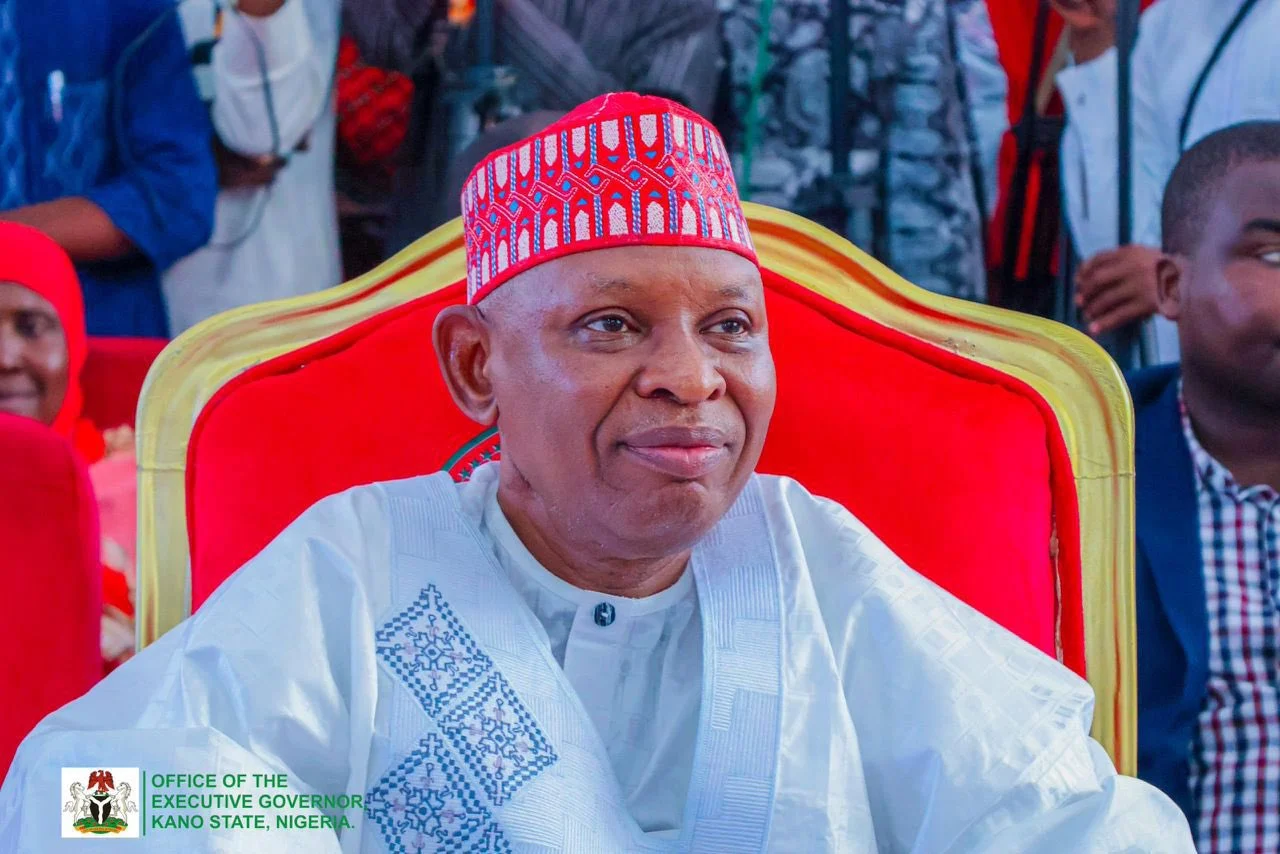
The Kano State Government has disclosed that it invested no less than N1.5bn in its latest mass wedding programme, provided 1,500 couples with financial assistance, household items and other support aimed at easing the cost of marriage and helping vulnerable residents establish new families.
The beneficiaries, comprising largely low-income residents, widows, divorcees, orphans, spinsters and bachelors, were formally married on Friday, August 7, 2026, in ceremonies coordinated by the Kano State Hisbah Board.
At the central ceremony held at the Emir’s Palace mosque, Governor Abba Kabir Yusuf represented the first groom, while the Emir of Kano, Muhammadu Sanusi II, represented the bride. The Chief Imam of Kano, Professor Sani Zahraddeen, offered prayers for the newly married couples.
Arewa PUNCH reports that the ceremony marked the second major mass wedding organised by the Yusuf administration, following the marriage of about 1,800 couples in 2023.
But beyond the colourful ceremony, the latest intervention was structured to address some of the financial and social challenges that prevent many residents from getting married.
Speaking on Saturday during a reception and distribution of furniture and other support items to the newly married couples in Kano, Yusuf disclosed that the state government spent N1.5bn on the latest mass wedding programme under its Auren Gata initiative.
“The Kano State Government has invested N1.5bn in this mass wedding programme to provide the beneficiaries with financial assistance, household items and other support to help them establish stable homes,” Yusuf disclosed.
The governor said a significant portion of the expenditure was used for medical screening of the brides and grooms as part of measures to safeguard their health and the wellbeing of their future children.
He added that the government also provided financial assistance and household necessities to reduce the economic pressure on the newly married couples.
Under the government’s support package, each groom will receive 10 yards of shadda fabric, a cap, a bag of rice and a jerrycan of cooking oil.
Each bride will receive N200,000 for dowry and business support, alongside household items including a bed, mattress, wardrobe, dressing mirror, blankets, bedsheets and a centre rug.
The beneficiaries also underwent medical screening and counselling before the marriages, with health checks covering conditions that included HIV, hepatitis and genotype compatibility.
The Kano State Hisbah Board, which coordinated the programme, also screened and verified applicants before they were selected.
The Commander-General of the Hisbah Board, Sheikh Aminu Ibrahim Daurawa, said the process was designed to ensure that the beneficiaries were properly prepared for marriage and that the necessary safeguards were observed.
“The beneficiaries underwent thorough screening and counselling before the marriages were conducted, while all religious and legal requirements were duly fulfilled,” Daurawa said.
He added that the intervention was not simply about bringing couples together but also about ensuring that the beneficiaries entered marriage with the necessary preparation.
“We want the couples to begin their married lives on a sound foundation, with proper counselling and the necessary medical and religious requirements fulfilled,” he said.
Our correspondent reports that for some of the beneficiaries, however, the programme represented far more than assistance with marriage expenses. It provided an opportunity to begin again after years of hardship, disappointment and personal tragedy.
One of the most striking beneficiaries was Haruna Bashir, who lost his wife, Fatima Abubakar, and their six children in an attack at their home in Dorayi Chiranchi Quarters, Kano, in January 2026.
The tragedy left Bashir facing the daunting prospect of rebuilding a life that had been shattered within a single incident.
Months later, he remarried Nabila Kabiru Yunusa through the state-sponsored mass wedding programme, with Governor Yusuf serving as his guardian during the solemnisation.
For Bashir, the wedding, therefore, represented more than the beginning of another marriage. It marked an attempt to move forward from an experience that had left him bereaved and emotionally devastated.
The governor’s intervention also went beyond the wedding ceremony. The state provided Bashir with a house in Amana City and sponsored his Umrah and Hajj as part of efforts to support him as he rebuilt his life.
The assistance offered to Bashir became one of the most striking examples of the programme’s humanitarian dimension, demonstrating how the initiative could be used to support beneficiaries facing circumstances beyond financial hardship.
For Governor Yusuf, the mass wedding was presented as part of a broader social intervention aimed at restoring hope, strengthening families and promoting moral values across Kano.
The governor said the initiative was designed to ease the financial burden associated with marriage and create opportunities for dignified family life in line with Islamic principles and Kano’s cultural heritage.
“The programme is a bold social intervention aimed at restoring hope, strengthening families and promoting moral values across the state,” Yusuf said.
He added that his administration was committed to supporting vulnerable residents by reducing the financial burden associated with marriage.
“Our intervention is intended to ease the financial burden of marriage and create opportunities for dignified family life in accordance with our Islamic principles and rich cultural heritage,” the governor said.
Yusuf also urged the newlyweds to exercise patience and uphold justice, fairness, mutual respect and peaceful coexistence in their homes.
“Mutual respect, patience and tolerance are essential for sustaining peaceful and successful marriages,” the governor said.
He reminded the couples that marriage was an act of worship, urging them to build their homes in accordance with the teachings of the Holy Quran and the Sunnah of Prophet Muhammad.
Yusuf further explained that the Auren Gata programme was one of the major promises made by his administration during its campaign across the 44 local government areas of the state ahead of the 2023 general elections.
The Emir of Kano, Muhammadu Sanusi II, also used the occasion to remind the newly married couples that the success of their marriages would depend on how they treated one another after the ceremony.
Sanusi urged the couples to build their homes around faith, patience, mutual respect and compassion.
“Build your homes on the enduring values of faith, patience, mutual respect and compassion,” the Emir told the couples.
While stressing the wider importance of stable families to society, Sanusi said, “Peaceful families remain the foundation of a stable and prosperous society.”
For another beneficiary, Ahmadu Abdulkadir Hussain, a physically impaired 300-level student of Ahmadu Bello University, Zaria, the intervention addressed a different form of hardship.
Despite having several qualifications and pursuing university education, Hussain said financial difficulties had frustrated his long-standing desire to marry.
“I have been longing for this opportunity, but I did not get it. Even though I am physically impaired, my several qualifications could not provide me with the resources to marry,” he said.
He said the government intervention had finally given him an opportunity he had struggled to achieve independently.
“I will forever be grateful to Governor Yusuf for this opportunity,” Hussain said.
For Abubakar Muntari, 35, the problem was the rising cost of living.
He said inflation and inadequate income had made marriage increasingly difficult despite his readiness to settle down.
“The cost of living has made marriage difficult for people like us who are willing to settle down but do not have enough income to meet all the expenses,” Muntari said.
He described the government programme as a major relief for people facing similar economic challenges.
“This programme has removed some of the financial pressure and given people like us an opportunity to marry,” he said.
Similarly, Mohammad Dala, 62, said the intervention enabled him to marry a second wife after years of lacking the financial capacity to do so.
“I have been longing to take a second wife because of the need, but I did not have the financial capacity to do so,” Dala said.
He said the government’s support made it possible for him to fulfil the long-held desire.
“With the mass wedding programme, through which the government is providing almost everything, including support to start a small business, I have been given the opportunity to take a second wife,” he added.
The intervention also offered a new opportunity to widows who had postponed remarriage because of family responsibilities.
One of them, Hajiya Sadiya Abubakar, a widow with two daughters, said she had initially intended to wait until she had married off her children before considering another marriage.
“To tell the truth, if no be this mass wedding, I no for marry now until after I marry off my daughters,” she said.
But the government programme changed her plans and created an opportunity she had not expected to take so soon.
“When I see this opportunity, God make me marry before my daughters,” Sadiya said.
The 2023 beginning
Arewa PUNCH reports further that the latest exercise builds on the first major mass wedding organised by the Yusuf administration in October 2023, when about 1,800 couples were married.
The ceremonies were decentralised across the state’s 44 local government areas to manage the large number of beneficiaries, with a central event held at the Emir’s Palace.
The government provided dowries, furniture, food, clothing and financial assistance, followed by a reception at Government House.
The programme was presented as part of the administration’s social intervention efforts to reduce the financial barriers to marriage, strengthen families and support vulnerable residents.
The large number of applications received for the scheme also reflected the growing financial pressure associated with marriage, particularly among low-income families.
Building on the first phase
For the 2026 edition, it was gathered that about 5,000 applications were reportedly received before 1,500 couples were selected following screening and verification.
The selection process included medical examinations, counselling and verification of the prospective couples.
Particular emphasis was placed on genotype testing, with officials saying the measure was intended to promote informed marital decisions and reduce the risk of preventable health complications among future children.
The support provided by the government also extends beyond the wedding ceremony.
The N200,000 given to each bride for dowry and business support is intended to provide some economic footing, while the household items supplied by the government reduce the immediate cost of setting up a home.
The programme also generates economic activity for local suppliers, including furniture makers, textile traders and businesses involved in the supply of household items and food products.
Not a few Kano observers who spoke with our correspondent maintained that the event confirmed that the government has positioned the intervention as both a social welfare programme and an investment in family formation.
They insist that for Governor Yusuf, “the significance of the initiative lies in its potential to address some of the pressures confronting vulnerable residents before they become deeper social problems.
“The governor has repeatedly described the mass wedding initiative as an intervention intended to restore hope and strengthen family institutions.
“The programme’s emphasis on screening and counselling also means the intervention is not simply about bringing couples together. It seeks to encourage healthier and more stable unions while preparing beneficiaries for the responsibilities of family life,” an observer, Awwual Kabir told Arewa PUNCH.
Another visibly impressed commentator, Muhammad Kiishi, told our correspondent, “for beneficiaries such as Bashir, the meaning of the programme is deeply personal.
“After losing his wife and six children in a devastating attack, the prospect of starting another family could hardly have been simple. Yet the state-sponsored wedding offered him not only a new marital beginning but additional assistance designed to help him rebuild his life.
“The house in Amana City, together with the sponsorship for Umrah and Hajj, placed his case beyond the standard package provided to the 1,500 beneficiaries.
“It is a highly visible example of how government’s intervention can respond to individual vulnerability while pursuing a broader social objective,” he said.
In the estimation of a Kano top government official who does not want his name in print because he is not authorised to speak, “The continued demand for the programme, reflected in the thousands of applications received for the latest phase, shows the extent of the financial pressure surrounding marriage in Kano.
“For the 1,500 couples who began married life in August 2026, the government’s support represents more than a wedding ceremony.
“It means starting a household with financial assistance, basic household necessities and, for some beneficiaries, a renewed sense of hope after years of hardship, widowhood, disability or personal tragedy.
“For the Yusuf administration, the programme represents an investment in families as a foundation for social stability.
“And for beneficiaries such as Haruna Bashir, the intervention has taken on an even more profound meaning: after losing the family he once knew, the government-supported marriage has given him an opportunity to begin rebuilding his life, with the state providing not only the ceremony but a measure of practical support for the difficult journey ahead,” he remarked.
The Chairman of the North-West Governors’ Forum and Katsina State Governor, Umar Dikko Radda, commended Yusuf for initiating the programme, describing it as an intervention aimed at improving the welfare and living conditions of residents.
Radda said the initiative demonstrated the importance of government interventions that directly addressed the economic challenges confronting families and vulnerable residents.
Earlier, the Commander-General of the Kano State Hisbah Board, Sheikh Aminu Ibrahim Daurawa, said the mass wedding programme had attracted recognition within Nigeria and beyond.
Daurawa said the initiative was designed not only to provide financial assistance to young couples but also to prepare them for the responsibilities and challenges of married life.
He said the screening, counselling and other processes involved in the programme were intended to promote stable marriages and strengthen family institutions.
Some beneficiaries, including Muhammed Bello and Hadiza Ibrahim, expressed appreciation to the Kano State Government for introducing the initiative.
They urged the government to sustain and expand the programme to enable more residents who face financial difficulties to benefit from the scheme.
The mass wedding programme is part of the Yusuf administration’s broader social intervention efforts aimed at reducing the financial barriers to marriage, supporting vulnerable residents and strengthening families across Kano State.